
The Vietnam carbon dioxide storage capacity
Tóm tắt
Our planet is warmed by a natural greenhouse effect and without this natural greenhouse effect the mean annual temperature on the earth would be about -6°C instead of its present level. Most of the natural greenhouse effect is known to be caused by water vapor and carbon dioxide in the atmosphere. However, water vapor is not classed as an anthropogenic greenhouse gas. Carbon dioxide is released into the atmosphere by the burning of solid waste, wood and wood products, and fossil fuels (oil, natural gas, and coal). As a result of human’s activities, the concentration of CO2 in the atmosphere has risen from a relatively stable level around 275 part per million (ppm) in the pre-industrial era to about 355ppm (1994), and currently continues to rise at a rate of about 1.8ppm per year. According to a study by the United Nations, Vietnam is in the top rank amongst countries hardest suffer by climate change catastrophes.
In 2006, Vietnam had 10 typhoons of which 3 were particularly destructive, resulting in 500 people being killed and 2,900 injured. Sea dykes were broken, 86,000 houses were destroyed, 74,000 roofs were blown away and 3,300 ships sank or were damaged.
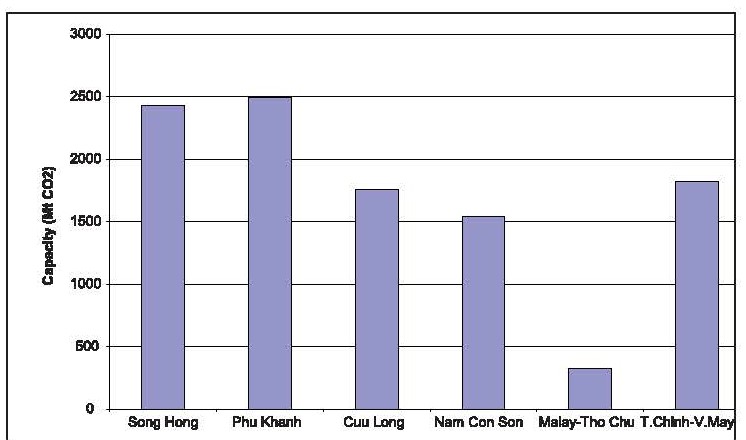
In order to restrict global temperature rise due to rising CO2, emissions into the atmosphere, one idea of is to capture such CO2, and store this gas in reservoirs almost completely shut off from the atmosphere in the deeper subsurface. This paper presents an assessment of the theoretical carbon dioxide storage capacity of deep-seated reservoirs in Vietnam’s oil and gas fields.
Các tài liệu tham khảo
2. RETA 7575: Determining the potential for carbon capture and storage in Southeast Asia, Viet Nam Country Report - Summary (Vietnam Ministry of Industry and Trade and Asian development Bank co-project, 2011).
3. Địa chất và Tài nguyên Dầu khí Việt Nam. NXB Khoa học - Kỹ thuật. 2007.
1. Tác giả giao bản quyền bài viết (tác phẩm) cho Tạp chí Dầu khí, bao gồm quyền xuất bản, tái bản, bán và phân phối toàn bộ hoặc một phần tác phẩm trong các ấn bản điện tử và in của Tạp chí Dầu khí.
2. Bằng cách chuyển nhượng bản quyền này cho Tạp chí Dầu khí, việc sao chép, đăng hoặc sử dụng một phần hay toàn bộ tác phẩm nào của Tạp chí Dầu khí trên bất kỳ phương tiện nào phải trích dẫn đầy đủ, phù hợp về hình thức và nội dung như sau: tiêu đề của bài viết, tên tác giả, tên tạp chí, tập, số, năm, chủ sở hữu bản quyền theo quy định, số DOI. Liên kết đến bài viết cuối cùng được công bố trên trang web của Tạp chí Dầu khí được khuyến khích.