Preliminary assessment of the characteristics of Late Miocene - Quaternary intrusive and extrusive magmatism in the Tu Chinh - Vung May basin, southeastern continental shelf of Vietnam
Tóm tắt
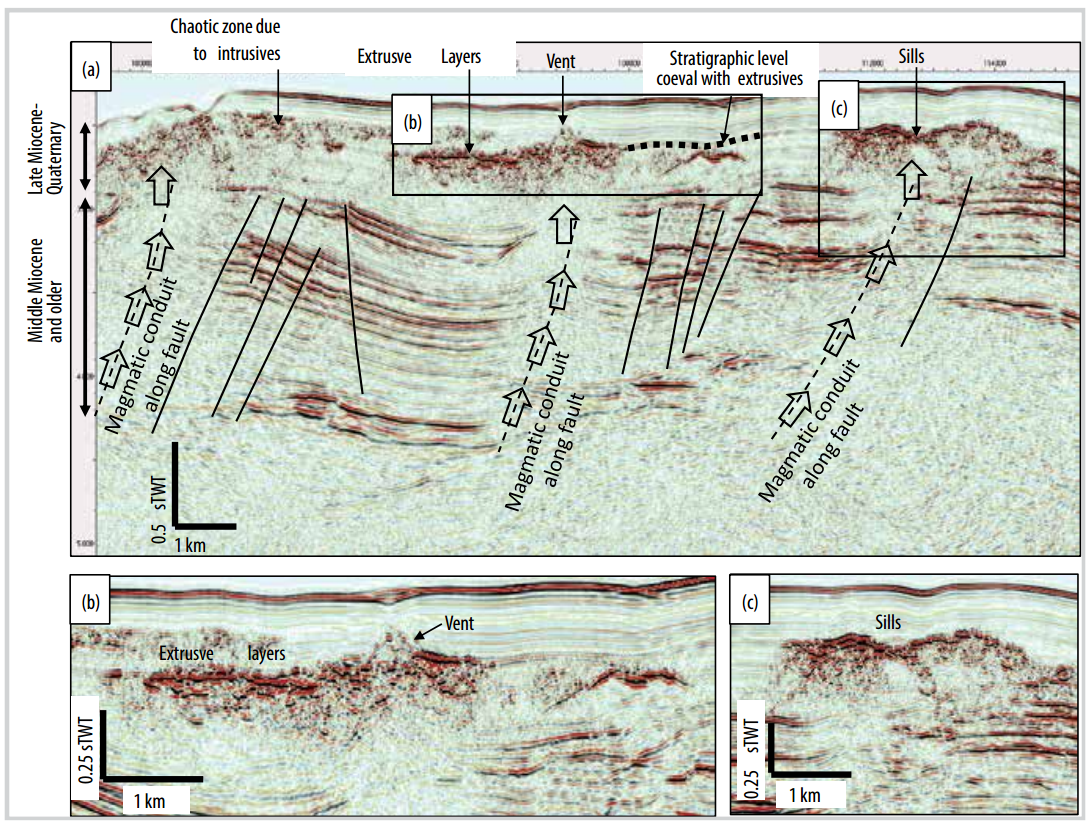
Based on the seismic and well dataset provided by the Vietnam Petroleum Institute (VPI), the authors have mapped and described the characteristics of the distribution and morphology of magmatic bodies as well as relatively dated them in the Tu Chinh - Vung May basin and adjacent areas. To distinguish magmatic bodies from other amplitude anomalies such as gas zone or carbonate build-up/layers, multiple criteria were used such as cross-cutting relationship, associated deformation of surrounding strata, morphology and geological relationship between different magmatic bodies. Intrusive bodies are usually sheet-like or saucer-shaped sills that cross-cut strata and even deform overlying strata, while extrusive bodies are usually cone-shaped vents/volcanoes or extensive lava sheets that conform to strata. The magmatic bodies often distribute in clusters around one or more magmatic conduits. Middle Miocene and older syn-rift faults controlled the pathway of the conduits. Magmatic bodies are more abundant closer to the East Sea spreading margin. Late Miocene - Quaternary magmatism is widespread in the study area in particular, and in the East Sea and adjacent areas in general. These activities took place after rifting and oceanic crust formation had ended, which is characteristic of magma-poor margins.
Các tài liệu tham khảo
Trịnh Xuân Cường và nnk, "Thu thập, phân tích, tổng hợp các tài liệu về khí hydrate để xác lập các dấu hiệu, tiền đề về tiềm năng khí hydrate ở các vùng biển và thềm lục địa Việt Nam", Viện Dầu khí Việt Nam, 2016.
Lê Chi Mai và nnk, “Đặc điểm trầm tích nước sâu tầng cấu trúc post-rift và triển vọng dầu khí của chúng trong khu vực Nam bể Phú Khánh, Đông Nam bể Nam Côn Sơn và bể Tư Chính - Vũng Mây”, Viện Dầu khí Việt Nam, 2019.
Xiaoxiao Song, Chun-Feng Li, Yongjian Yao, and HeshengShie, "Magmatism in the evolution of the South China Sea: Geophysical characterization", Marine Geology, Vol. 394, pp. 4 - 15, 2017. DOI: 10.1016/j.margeo.2017.07.021.
Michael B.W. Fyhn, Boldreel Lars O. Boldreel, and Lars H. Nielsen, "Geological development of the Central and South Vietnamese margin: Implications for the establishment of the South China Sea, Indochinese escape tectonics and Cenozoic volcanism", Tectonophysics, Vol. 478, No. 3 - 4, pp. 184 - 214, 2009. DOI: 10.1016/j.tecto.2009.08.002.
C.K. Morley, "Major unconformities/termination of extension events and associated surfaces in the South China Seas: Review and implications for tectonic development", Journal of Asian Earth Sciences, Vol. 120, pp. 62 - 86, 2016. DOI: 10.1016/j.jseaes.2016.01.013.
VPI and PVEP-POC, Structural-tectonic model study for Block 05-1a, 2019.
Franke Dieter, Savva Dimitri, Pubellier Manuel, Stephan Steuer, Benoit Mouly, Jean-Luc Auxietre, Florian Meresse, and Nicolas Chamot-Rooke, "The final rifting evolution in the South China Sea", Marine and Petroleum Geology, Vol. 58, pp. 704 - 720, 2014. DOI: 10.1016/j.marpetgeo.2013.11.020.
Savva Dimitri, Pubellier Manuel, Franke Dieter, Nicolas Chamot-Rooke, Florian Meresse, Stephan Steuer, and Jean-Luc Auxietre, "Different expressions of rifting on the South China Sea margins", Marine and Petroleum Geology, Vol. 58, pp. 579 - 598, 2014. DOI: 10.1016/j.marpetgeo.2014.05.023.
Nguyen Hoang and Martin Flower, "Petrogenesis of Cenozoic basalts from Vietnam: Implication for origins of a “Diffuse igneous province”", Journal of Petrology, Vol. 39, No 3, pp. 369 - 395, 1998. DOI: 10.1093/petroj/39.3.369.
Nguyễn Hoàng, Martin F.J. Flower, Cung Thượng Chí, Phạm Tích Xuân, Hoàng Văn Quý, and Trần Thanh Sơn, "Collision-induced basalt eruptions at Pleiku and Buon Me Thuot, south-central Viet Nam", Journal of Geodynamics, Vol. 69, pp. 65 - 83, 2013. DOI: 10.1016/j.jog.2012.03.012.
Fang Zhao, Tiago M. Alves, Wu Shiguo, Li Wei, Mads Huuse, Lijun Mi, Qiliang Sun, and Benjun Ma, "Prolonged post-rift magmatism on highly extended crust of divergent continental margins (Baiyun Sag, South China Sea)", Earth and Planetary Science Letters, Vol. 445, pp. 79 - 91, 2016. DOI: 10.1016/j.epsl.2016.04.001.
Lijie Wang, Zhen Sun, Jinhai Yang, Zhipeng Sun, Jitian Zhu, Haiteng Zhuo, and Joann Stock, "Seismic characteristics and evolution of post-rift igneous complexes and hydrothermal vents in the Lingshui sag (Qiongdongnan basin), Northwestern South China Sea", Marine Geology, Vol. 418, 2019. DOI: 10.1016/j.margeo.2019.106043.
Quanshu Yan, Xuefa Shi, and Paterno R. Castillo, "The Late Mesozoi-Cenozoic tectonic evolution of the South China Sea: A petrologic perspective", Journal of Asian Earth Sciences, Vol. 85, pp. 178 - 201, 2019. DOI: 10.1016/j.jseaes.2014.02.005.
S. Planke, T. Rasmussen, S.S. Rey, and R. Myklebust, "Seismic characteristics and distribution of volcanic intrusions and hydrothermal vent complexes in the Vøring and Møre basins", Petroleum Geology North-West Europe and Global Perspective, Vol. 6, pp. 833 - 844, 2005. DOI: 10.1144/0060833.
Qiliang Sun, Christopher A.L. Jackson, Craig Magee, Samuel J. Mitchell, and Xinong Xie1, "Extrusion dynamics of deepwater volcanoes revealed by 3-D seismic data",Solid Earth, Vol. 10, No. 4, pp. 1269 - 1282, 2019. DOI: 10.5194/se-10-1269-2019.
Guoping Zuo and Guozhang Fan, "A study of volcanic rocks identification by seismic methods in Subei basin, Jiangsu province, China", AAPG Annual Convention and Exhibiton, Houston, Texas, USA, 10 - 13 April 2011.
Pin Yan, Hui Deng, Hailing Liu, Zhirong Zhang, and Yukun Jiang, "The temporal and spatial distribution of volcanism in the South China Sea region", Journal of Asian Earth Sciences, Vol. 27, No. 5, pp. 647 - 659. DOI: 0.1016/j.jseaes.2005.06.005.
1. Tác giả giao bản quyền bài viết (tác phẩm) cho Tạp chí Dầu khí, bao gồm quyền xuất bản, tái bản, bán và phân phối toàn bộ hoặc một phần tác phẩm trong các ấn bản điện tử và in của Tạp chí Dầu khí.
2. Bằng cách chuyển nhượng bản quyền này cho Tạp chí Dầu khí, việc sao chép, đăng hoặc sử dụng một phần hay toàn bộ tác phẩm nào của Tạp chí Dầu khí trên bất kỳ phương tiện nào phải trích dẫn đầy đủ, phù hợp về hình thức và nội dung như sau: tiêu đề của bài viết, tên tác giả, tên tạp chí, tập, số, năm, chủ sở hữu bản quyền theo quy định, số DOI. Liên kết đến bài viết cuối cùng được công bố trên trang web của Tạp chí Dầu khí được khuyến khích.