Classification and petrophysical characterisation of miocene carbonate reservoir in well RR02, Song Hong basin, Vietnam
Abstract
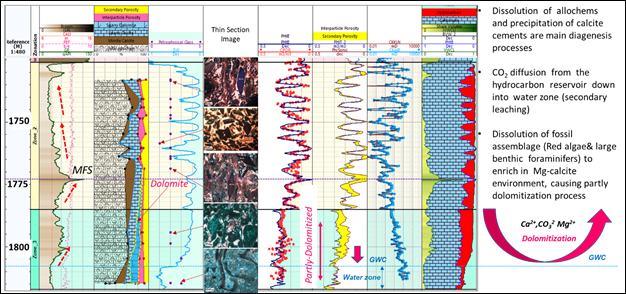
This study performs an integrated method using thin section and well log data to determine rock fabrics and their relationship with the rock pore system in Miocene carbonate reservoirs of well RR02, southern Song Hong basin, Vietnam. By thin section analysis, mineral components and pore types of carbonate rocks were determined, creating a basis for carbonate classification and grouping samples into different petrophysical classes. Zoning, identification of dominant changing trend of the petrographic composition and porosity estimation were then conducted based on the combination of different standard log curves, including gamma ray (GR), photoelectric factor (PEF), neutron porosity (NPHI), density (RHOB) and sonic (DT). Four types of rock fabrics were diagnosed along a nearly 90m-thick carbonate reservoir, namely, grainstone, grain-dominated packstone, wackstone and boundstone. Two main pore types were found corresponding to each identified carbonate fabric, including interparticle and vuggy pores estimated by well log interpretation in the range of 5.9% to 10% and 2.9% to 21.5%, respectively. In well RR02, carbonate reservoir was mostly formed by limestone and could be divided into 2 zones with the lower affected by dolomitisation proved by the results of petrographic analysis, log curve characteristics and well log interpretation.
References
[2] Vivian K.Bust, Joshua U.Oletu, and Paul F.Worthington, "The challenges for carbonate petrophysics in petroleum resource estimation", SPE Reservoir Evaluation & Engineering, Vol. 14, No. 1, pp. 25 - 34, 2011. DOI: 10.2118/142819-PA.
[3] Robert L.Folk, “Spectral subdivision of limestone types”, Classification of carbonate rocks - A symposium, AAPG Memoir, Vol. 1, pp. 62 - 84, 1962. DOI: 10.1306/M1357.
[4] F.J.Lucia, "Petrophysical parameters estimated from visual descriptions of carbonate rocks: A field classification of carbonate pore space", Journal of Petroleum Technology, Vol. 35, No. 3, pp. 629 - 637, 1983. DOI: 10.2118/10073-PA.
[5] Robert J.Dunham, “Classification of carbonate rocks according to depositional texture”, Classification of carbonate rocks - A symposium, AAPG Memoir, Vol. 1, pp. 108 - 121, 1962. DOI: 10.1306/M1357.
[6] Philip W.Choquette and Lloyd Charles Pray, "Geologic nomenclature and classification of porosity in sedimentary carbonate", AAPG Bulletin, Vol. 54, No. 2, pp. 207 - 250, 1970.
[7] F.Jerry Lucia, "Rock-fabric/petrophysical classification of carbonate pore space for reservoir characterization", AAPG Bulletin, Vol. 79, No. 9, pp. 1275 - 1300, 1995. DOI: 10.1306/7834D4A4-1721-11D7- 8645000102C1865D.
[8] J.A.Burke, R.L.Campbell, and A.W.Schmidt, “The litho-porosity cross plot - A method of determining rock characteristics for computation of log data”, SPE Illinois Basin Regional Meeting, Evansville, Indiana, 30 - 31 October, 1969.
[9] Robert Cluff, Suzanne Cluff, Ryan Sharma, and Chris Sutton, “A deterministic lithology model for the green river-upper wasatch interval of the Uinta basin”, AAPG Annual Convention & Exhibition 2015, Denver, Colorado, 31 May - 3 June, 2015.
[10] Schlumberger, Log interpretation. Principles/Applications. Texas: 1989.
1. The Author assigns all copyright in and to the article (the Work) to the Petrovietnam Journal, including the right to publish, republish, transmit, sell and distribute the Work in whole or in part in electronic and print editions of the Journal, in all media of expression now known or later developed.
2. By this assignment of copyright to the Petrovietnam Journal, reproduction, posting, transmission, distribution or other use of the Work in whole or in part in any medium by the Author requires a full citation to the Journal, suitable in form and content as follows: title of article, authors’ names, journal title, volume, issue, year, copyright owner as specified in the Journal, DOI number. Links to the final article published on the website of the Journal are encouraged.